Card dossier
| Card | The Fool |
|---|---|
| Arcana / Suit | Major Arcana (No. 00) |
| Element / Astrology | Air / Uranus |
| Upright themes | Beginnings; openness |
| Reversed reflection | Hesitation, fear of the unknown, or impulsive leaps without grounding |
| Suggested spread | Three cards: past, present and future |
In the quiet, wood-paneled chambers of the Grand Hotel Tarozon, I have spent years observing the silent dialogue between the seeker and the cards. Among the seventy-eight archetypes that populate the deck, none captures the raw, unbridled energy of existence quite like The Fool. Numbered zero, The Fool represents a state of pure consciousness—the point before the story begins, the breath before the leap, and the blank page waiting for the first ink.
To draw The Fool is to encounter the spirit of the beginner. It is not an invitation to act foolishly, but rather an invitation to act with the clarity of someone who is not yet burdened by the “shoulds” and “musts” of the world. It is the archetype of the adventurous soul, standing at the edge of a precipice, ready to embrace the unknown with trust rather than trepidation.
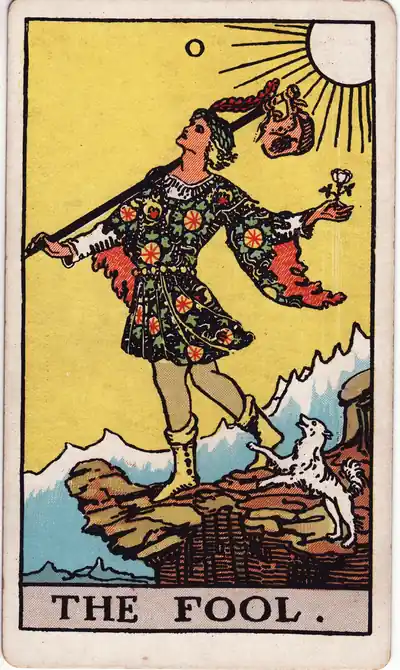
Visual Symbolism in the Rider-Waite-Smith Deck
The imagery of The Fool, as illustrated by Pamela Colman Smith, is a masterclass in narrative economy. Each element serves as a psychological anchor for the seeker.
- The White Rose: A symbol of purity, innocence, and the freedom from past conditioning. It suggests that the traveler’s intentions are clear and unclouded by ego or malice.
- The Small White Dog: Often interpreted as the companion of the instinctual self. It leaps alongside the traveler, acting as both a protector and a reminder to remain grounded in the present moment.
- The Knapsack: This contains the bare necessities of life. It signifies that the traveler is unburdened by material excess, carrying only what is essential for the journey ahead.
- The Precipice: A symbol of the threshold of change. It represents the point of no return where fear and excitement converge, inviting the seeker to trust their intuition over their logic.
- The Bright Sun: A beacon of vitality and divine guidance. It illuminates the path, suggesting that despite the lack of a map, there is an inherent goodness and warmth in the universe that supports the act of beginning.
The Psychological Mirror: Upright and Reversed
The Fool is a mirror for our own inner state of readiness. When we examine this card, we are looking at our capacity for vulnerability.
The Upright Expression: Embracing the Leap
When The Fool appears upright, it reflects a period of openness. Psychologically, this is the state of “beginner’s mind.” It is the courage to start a creative project, embark on a new relationship, or change one’s perspective, even when the outcome is uncertain. It is the manifestation of trust—not in a specific result, but in one’s own ability to handle whatever the road provides.
The Reversed Reflection: The Shadow of Hesitation
When The Fool is inverted, it often signals a fear of the unknown that has manifested as paralyzing inaction. It may suggest a tendency to be reckless, to leap without looking, or conversely, to remain frozen in place because one is waiting for a “guarantee” of success. It invites us to look at where we are clinging to outdated routines out of fear of the vulnerability that comes with starting over.
Notes from the Reading Table: A Real Consultation Case
In my years at the Grand Hotel Tarozon, I recall a session with a client named Julian (pseudonym). Julian arrived at my table during a period of professional exhaustion. He had spent fifteen years in a high-pressure corporate role that left him feeling hollow. He felt the urge to quit, but the weight of his identity as a “successful professional” kept him anchored to a life he no longer recognized.
When The Fool appeared on the table, Julian sighed, his shoulders dropping as if he were seeing a mirror of his own secret desire. He looked at the imagery of the traveler—the small bag, the open sky—and confessed that he felt like he was “starting from zero” at age forty. We spoke not about the financial implications of his decision, but about the psychological weight of the “knapsack” he had been carrying—the expectations of his peers, his family, and his own younger self.
The breakthrough occurred when he realized that being “The Fool” was not an act of insanity, but an act of authenticity.
“Perhaps the fear of being a beginner is just the fear of being seen as I truly am, without the armor of my credentials. The Fool isn’t lost; he’s just the only one who isn’t afraid of the view from the edge.”
Julian did not quit his job that day based on the card; rather, he left the table with the resolve to investigate his own potential. He began taking evening classes in a field he had long suppressed, choosing to walk toward the edge of his comfort zone with curiosity rather than fear.
Multi-Dimensional Life Guidance
Love and Relationships
The Fool in matters of the heart represents a fresh start. It is the willingness to be vulnerable with another person, free from the baggage of past heartbreaks. It encourages you to approach a partner with a sense of wonder and playfulness. If you are seeking connection, it asks you to drop your defenses and be open to the unexpected.
Career and Financial Path
In a professional context, this card is not a directive to quit your job or take wild financial risks. Instead, it is an invitation to bring a sense of innovation and “newness” to your current path. It asks: “If I were starting today, what would I do differently?” It encourages you to view your career as a series of adventures rather than a linear climb.
Personal Growth and Inner Work
This is the ultimate card for self-discovery. It invites you to strip away the labels you have placed upon yourself. Growth, in the eyes of The Fool, is the process of unlearning. It asks you to trust your inner compass and to find the courage to embark on the inner work of self-acceptance, regardless of what the world deems “sensible.”
Mindful Action Plan
To integrate the energy of The Fool, practice the “Beginner’s Walk.” Once a week, commit to doing something you are completely unskilled at. It might be sketching, learning a few words of a new language, or taking a new route to a familiar place. The goal is not to achieve mastery, but to experience the sensation of not-knowing, and to find joy in the process of discovery. Observe how your body reacts to the lack of a plan—if you feel anxiety, breathe into it. If you feel excitement, lean into it.
“I release the need for certainty and welcome the infinite potential of this moment. I trust my path, even when I cannot see where it leads.”